
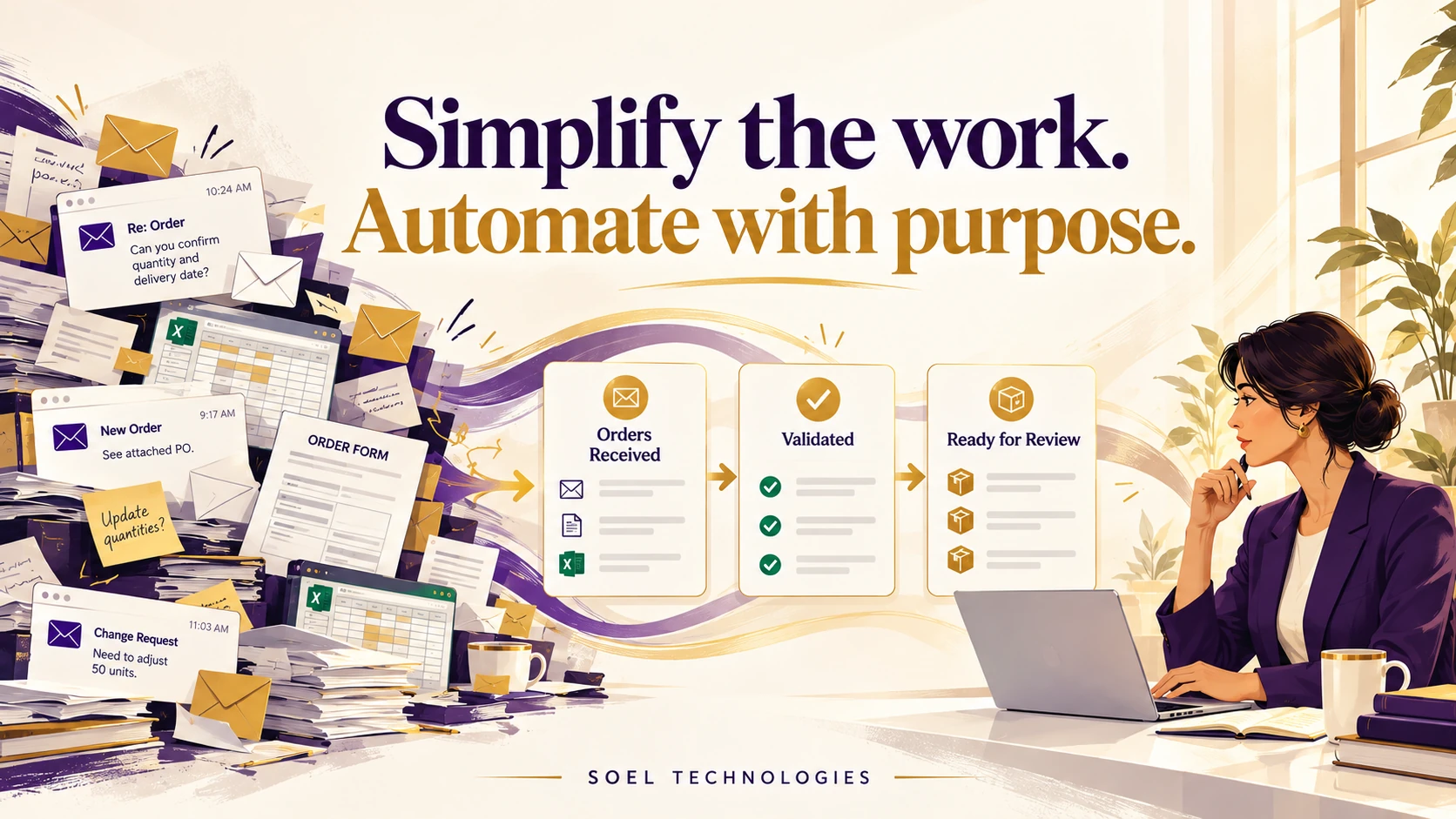
A customer order arrives by email. Someone copies the details into a spreadsheet, checks availability in another system, and forwards it for approval. Missing information triggers more emails. By the time the order is ready, several people have touched the same data.
Automating this workflow sounds straightforward. But where should you begin?
You could automate the data entry. You could introduce AI to read the emails. You could build an entirely new application.
At Soel Technologies, our Intelligent Automation Principles guide that decision. They help us connect technology choices to operational outcomes, with six practical principles.
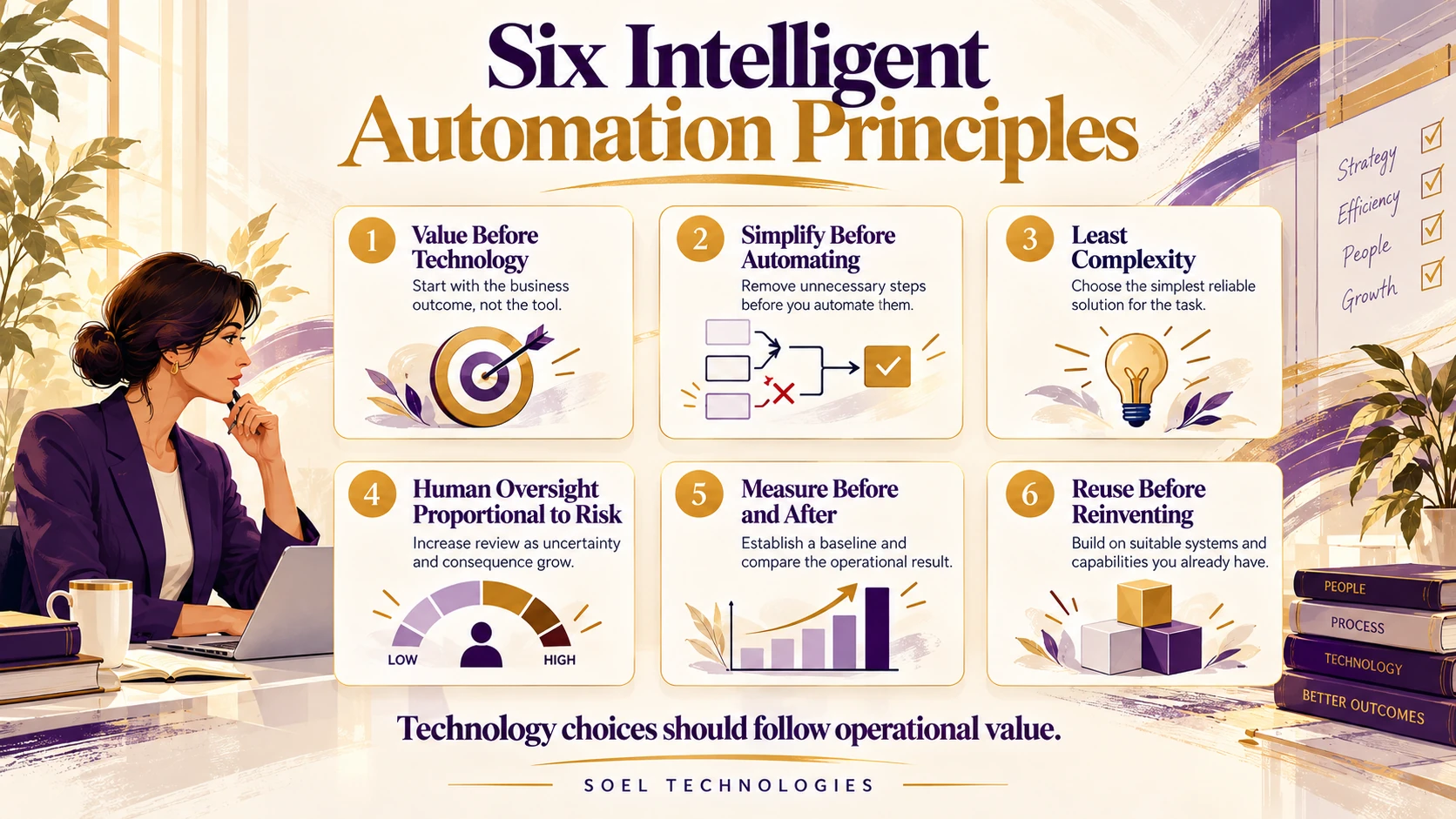
Start with the business outcome.
A team might need to process orders faster, reduce invoice errors, identify inventory risks earlier, or spend less time reviewing routine exceptions. Each problem calls for a different response.
Before selecting technology, define:
- What problem are we solving?
- Who experiences it?
- What does it cost in time, money, or missed opportunities?
- What would a meaningful improvement look like?
“Introduce AI into order processing” describes a technology choice. “Reduce the time between receiving an order and confirming it” describes an outcome.
That outcome provides a basis for prioritizing the work and evaluating the result.
Do not automate a poor process simply to make the poor process run faster.
A workflow may contain duplicate data entry, unnecessary approvals, unclear responsibilities, or handoffs that no longer serve a purpose.
Automating those steps can preserve the very problems the organization wants to solve.
In our order-processing example, the first improvement might be a standard intake form, a clear approval rule, or removing a spreadsheet that duplicates information already held elsewhere.
Once the process is simpler, the automation has a clearer job to do. It also becomes easier to maintain and explain to the people using it.
Choose the simplest reliable technology capable of delivering the required outcome.
Some problems need a formula. Others need a rules-based workflow, a system integration, or a dashboard. AI becomes useful when the task involves interpreting unstructured information, making predictions, classifying content, or reasoning through context.
For example, checking whether an order contains a customer number can be handled by a straightforward validation rule. Extracting order details from differently formatted emails may justify AI.
The choice should reflect the task, the reliability required, and the team’s ability to support the solution.
Every additional component creates something else to manage. Complexity should earn its place through the value it adds.
Increase review as uncertainty and consequence grow.
A routine notification may require little oversight. Changing a supplier’s payment details or approving a significant purchase requires stronger controls.
In inventory planning, a system could automatically highlight products approaching a reorder threshold. A planner might review the proposed order when demand has changed sharply, the purchase is unusually large, or the underlying data is incomplete.
A practical workflow distinguishes between:
Can proceed within defined rules.
Need human review.
Require explicit approval.
People should have the context needed to make those decisions, including what triggered the exception and what action the system recommends.
Establish the baseline before introducing the solution.
If the aim is faster order processing, measure the current processing time. If the aim is fewer errors, define what counts as an error and record how often it occurs.
Useful measures may include processing time, manual effort, rework, unresolved exceptions, and cost per transaction.
After the pilot, compare results with that baseline. Account for changes in workload and include the time spent reviewing outputs, correcting mistakes, and maintaining the system.
Measurement helps the organization decide whether to expand, adjust, or stop a pilot.
Assess the tools and capabilities the organization already has.
Existing business systems, collaboration platforms, databases, and workflow tools may support much of the required solution.
Reusing suitable capabilities can reduce implementation effort and help employees work within familiar environments. It can also make ownership and ongoing support easier to establish.
The key is suitability. An existing platform should be reused when it meets the operational need, integrates appropriately, and can be supported reliably.
Where there is a clear gap, a new component may be justified.
Putting the Principles to Work
Return to the customer order that passes through emails, spreadsheets, and approvals.
Applying the principles could lead to a practical sequence:
Define the desired improvement in order-confirmation time.
Remove duplicate entry and unnecessary handoffs.
Use validation rules for predictable checks and AI where email interpretation adds value.
Route incomplete, unusual, or high-value orders for review.
Compare processing time and errors before and after the pilot.
Build on suitable existing systems.
The final solution follows from understanding the work.
That is how Soel approaches intelligent automation: identify valuable opportunities, improve the process, choose appropriate technology, and verify the operational result.

Where Could Your Operations Improve?
Consider a process your team repeats every day. Where does work wait? Where is information entered twice? Which exceptions consume the most attention?
Those questions provide a practical starting point.
Soel Technologies helps organizations explore automation opportunities and connect them to measurable business outcomes.